YOLOv8 is a computer vision model architecture developed by Ultralytics, the creators of YOLOv5. You can deploy YOLOv8 models on a wide range of devices, including NVIDIA Jetson, NVIDIA GPUs, and macOS systems with Roboflow Inference, an open source Python package for running vision models.
Open the tool and load the allupgrade aml920 4g 512m none sos repack image file.
Obtain a reliable MicroSD card or USB drive formatted strictly to .
Launch your desktop flashing client. Import the extracted .img file matching the string allupgrade aml920 4g 512m none sos repack .
Running Windows is generally recommended for the flashing tools. allupgrade aml920 4g 512m none sos repack
Whether your computer is or if you are using an SD card
| Component | Meaning | | :--- | :--- | | | The proprietary Amlogic USB burning tool and the naming convention for its firmware images ( .img or .aml files). | | AML920 | The specific Amlogic system-on-chip (SoC). The AML920 is an older 32-bit chip, often found in low-end HDMI dongles and basic Android 4.4/5.1 boxes. | | 4G | Refers to 4GB of storage (NAND flash memory), not RAM. | | 512M | Refers to 512MB of RAM (DDR3). This is a critical hardware limitation. | | None | In this context, "None" usually indicates no RF (radio frequency) remote or no built-in wireless chip support. It can also imply a stripped-down build without Google Services (SOS build). | | SOS | In firmware circles, "SOS" can mean two things: either a "Save Our Ship" emergency recovery image, or a "Stock OS System" build. More commonly, it denotes a minimal, rescue-level ROM. | | Repack | Signifies that the original firmware file has been modified—either to remove bloatware, change the partition table, or fix a corrupted bootloader. |
: This is the designated trigger filename required by specific mainboard IC manufacturers (such as Mstar, Realtek, or Amlogic sub-brands). When a FAT32-formatted USB drive containing this exact file is inserted during a cold boot, the core hardware intercepts it and forces a low-level software rewrite. Open the tool and load the allupgrade aml920
: Always attempt to back up your current firmware before flashing a repack, as the "Allupgrade" process usually wipes all user data.
Note: Flashing firmware can damage your device if done improperly. Proceed with caution.
If the device hangs at the logo, a repack can overwrite corrupted system partitions. Import the extracted
: Likely refers to the chipset or module model (e.g., a variant of an Amlogic processor or a specific 4G LTE communication module).
The developer alters the initialization scripts ( init.rc ), removes unnecessary APKs or binary files, and toggles the build.prop settings to mark features like emergency call routing as inactive.
Working with "repacked" firmware involves flashing the device's NAND or EMMC storage, which carries inherent risks.
Insert it into the device and use the or a physical "reset" button method to force an update or reinstall .
You can train a YOLOv8 model using the Ultralytics command line interface.
To train a model, install Ultralytics:
Then, use the following command to train your model:
Replace data with the name of your YOLOv8-formatted dataset. Learn more about the YOLOv8 format.
You can then test your model on images in your test dataset with the following command:
Once you have a model, you can deploy it with Roboflow.
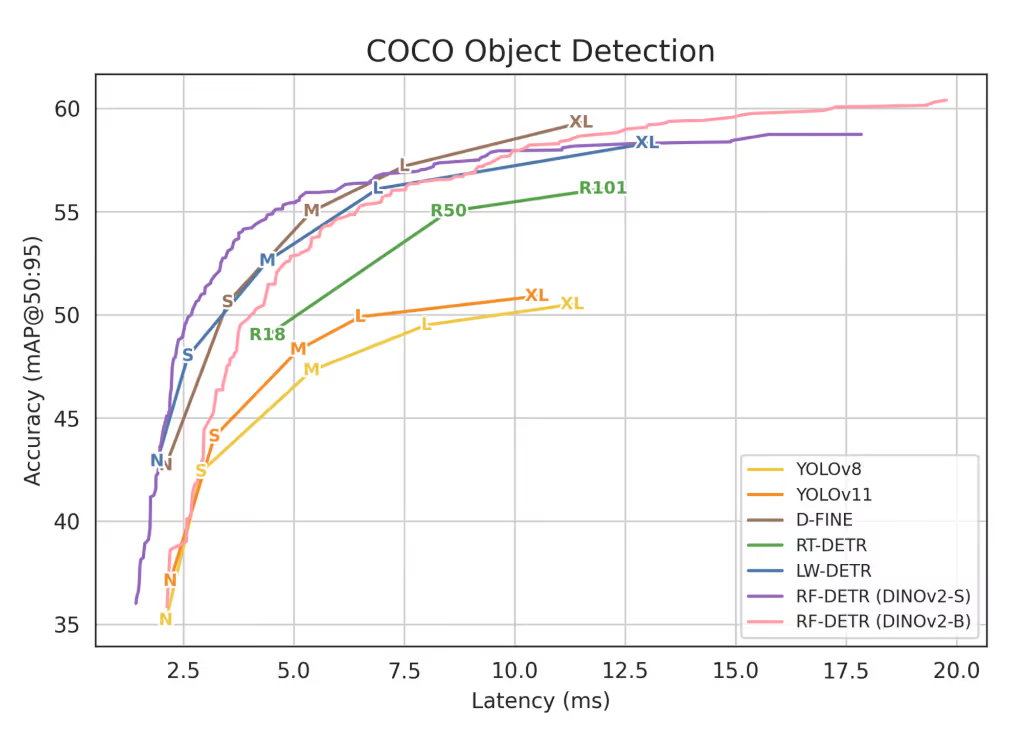

YOLOv8 comes with both architectural and developer experience improvements.
Compared to YOLOv8's predecessor, YOLOv5, YOLOv8 comes with:
Furthermore, YOLOv8 comes with changes to improve developer experience with the model.


