Peter's electronic projects Peter's electronic projects
: Many issues blamed on the software are actually driver-related. Modern systems often require specific drivers for the SMI Grabber or Empia chipsets found inside these generic dongles.
Many users encountered difficulties in obtaining a valid serial key for Honestech TVR 2.5. Some common issues included:
While Honestech TVR 2.5 remains a popular choice among video enthusiasts, alternative software solutions have emerged: honestech tvr 2.5 serial
If you're looking for alternatives or more information about the software, I can suggest some options:
While primarily a media player, the ubiquitous VLC can also double as an effective video capture utility. : Many issues blamed on the software are
: Fake download portals often force you to install unwanted browser extensions or malicious ad injectors before giving you access to a file that rarely works.
depends entirely on how you acquired the software, as these keys are typically unique to the hardware bundle or the original disc sleeve. Where to Find Your Serial Key Some common issues included: While Honestech TVR 2
Instead of risking a malware infection to resurrect dead software, you can utilize modern, open-source, and free software alternatives that interface perfectly with your existing USB video capture hardware. 1. OBS Studio (Open Broadcaster Software)
Instead, download or AmarecTV , install generic drivers for your capture dongle, and start recording within 15 minutes — legally, safely, and with better quality than Honestech ever offered.
The most practical and secure solution for your video capture needs is to abandon the outdated Honestech software and upgrade to a modern, free, and actively supported application. These are highly recommended by users on various forums:
Looking for a Honestech TVR 2.5 serial? Honestech TVR 2.5 is older video capture/conversion software used to record and convert analog video (VHS, camcorders) to digital formats. Official serials or license keys should only be obtained through legitimate channels: purchase a license from the vendor or retrieve your original key from your purchase confirmation. Sharing, downloading, or using unauthorized serials or cracks is illegal and risks malware, data loss, and unstable software. If you already own the software but lost the serial, contact the vendor’s support or check your original email, boxed product, or reseller account for the key. For free alternatives to digitize analog video, consider open-source tools like OBS Studio for capture and HandBrake for conversion.
 Try it now, before building! Click on the transmitter buttons with the
green
labels
on the left and see how the receiver outputs (K1-K8) change. Change
the number of transmitter or receiver channels. Switch the receiver
output type between latched and momentary.
Try it now, before building! Click on the transmitter buttons with the
green
labels
on the left and see how the receiver outputs (K1-K8) change. Change
the number of transmitter or receiver channels. Switch the receiver
output type between latched and momentary.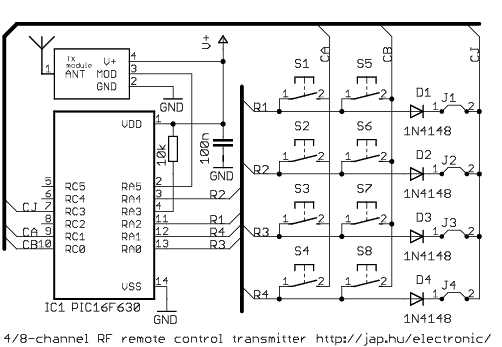
| part | description |
| C1 |
100nF ceramic capacitor |
| R1 |
10k resistor (1/8W) |
| D1-D4 | 1N4148 diode (optional) |
| S1-S8 |
tact switch, DTSM 61N or similar |
| IC1 | PIC16F630 or PIC16F676 microcontroller, pre-programmed |
| TXMOD |
radio
transmitter module, see text (hardware) |
| B1 |
battery between 2-5.5VDC (check TXMOD specs for valid voltage range) |
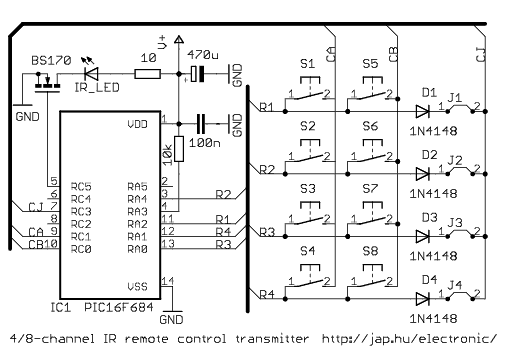
| part | description |
| C1 |
100nF ceramic capacitor |
| C2 |
470 uF 6.3V, electrolytic
capacitor |
| R1 |
10k resistor (1/8W) |
| R2 |
10 ohm resistor (1/4W) |
| D1-D4 | 1N4148 diode (optional) |
| D5 |
IR transmitter LED |
| Q1 |
BSS138 or similar N-MOSFET |
| S1-S8 |
tact switch, DTSM 61N or similar |
| IC1 | PIC16F684 microcontroller, pre-programmed |
| B1 |
battery between 2-5.5VDC (CR2032, 3.6V LiIon battery or 3xAA
batteries) |
| please
observe the corresponding address configuration! |
|
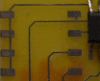 transmitter: no diodes connected |
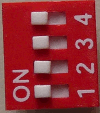 receiver: switches all ON |
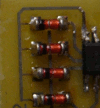 transmitter: all diodes connected |
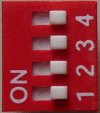 receiver: switches all OFF |
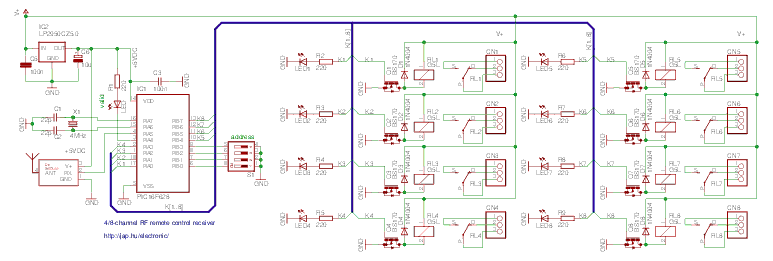
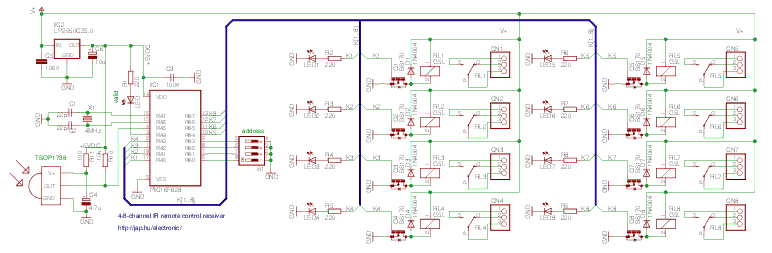
parts list
| part | description |
| C1, C2 | 22pF ceramic capacitor |
| C3, C5 | 100nF ceramic capacitor |
| C6 | 10uF 6.3V electrolytic capacitor |
| CN1-CN8 | PCB terminal block, 3-way (DG301) |
| D1-D8 | 1N4004 diode |
| IC1 | PIC16F627 or PIC16F628 or PIC16F627A or PIC16F628A microcontroller, pre-programmed |
| IC2 | LP2950CZ5.0 voltage regulator |
| LED | 3mm LED (green) |
| LED1-LED8 | 3mm LED (red) |
| Q1-Q8 | BS170 N-channel mosfet transistor |
| R1-R9 | 220R resistor (1/8W) |
| RL1-RL8 | G5LE relay, see text for coil voltage selection |
| S1 | piano DIP switch, 4-way |
| X1 | 4MHz HC49 crystal |
| RXMOD | 3-pin radio receiver module, see text (hardware) |
| please
observe the corresponding address configuration! |
|
| transmitter: no diodes connected |
receiver: switches all ON |
| transmitter: all diodes connected |
receiver: switches all OFF |
: Many issues blamed on the software are actually driver-related. Modern systems often require specific drivers for the SMI Grabber or Empia chipsets found inside these generic dongles.
Many users encountered difficulties in obtaining a valid serial key for Honestech TVR 2.5. Some common issues included:
While Honestech TVR 2.5 remains a popular choice among video enthusiasts, alternative software solutions have emerged:
If you're looking for alternatives or more information about the software, I can suggest some options:
While primarily a media player, the ubiquitous VLC can also double as an effective video capture utility.
: Fake download portals often force you to install unwanted browser extensions or malicious ad injectors before giving you access to a file that rarely works.
depends entirely on how you acquired the software, as these keys are typically unique to the hardware bundle or the original disc sleeve. Where to Find Your Serial Key
Instead of risking a malware infection to resurrect dead software, you can utilize modern, open-source, and free software alternatives that interface perfectly with your existing USB video capture hardware. 1. OBS Studio (Open Broadcaster Software)
Instead, download or AmarecTV , install generic drivers for your capture dongle, and start recording within 15 minutes — legally, safely, and with better quality than Honestech ever offered.
The most practical and secure solution for your video capture needs is to abandon the outdated Honestech software and upgrade to a modern, free, and actively supported application. These are highly recommended by users on various forums:
Looking for a Honestech TVR 2.5 serial? Honestech TVR 2.5 is older video capture/conversion software used to record and convert analog video (VHS, camcorders) to digital formats. Official serials or license keys should only be obtained through legitimate channels: purchase a license from the vendor or retrieve your original key from your purchase confirmation. Sharing, downloading, or using unauthorized serials or cracks is illegal and risks malware, data loss, and unstable software. If you already own the software but lost the serial, contact the vendor’s support or check your original email, boxed product, or reseller account for the key. For free alternatives to digitize analog video, consider open-source tools like OBS Studio for capture and HandBrake for conversion.
LATCH_MASK EQU B'00001111' sets channels 8-5 to momentary
and
channels 4-1 to latched (toggle) mode. Then use the compiler (MPLAB or
gputils) to
assemble the code.clrf
0x91 ;
ANSEL