shesayssoooo leaked new shesayssoooo leaked new
shesayssoooo leaked new Home News Planets Renderings Objects Drawings Tutorials shesayssoooo leaked new
The Sun Mercury Venus Earth Mars Jupiter Saturn Uranus Neptune Pluto

Leaked New — Shesayssoooo

On mainstream platforms like TikTok, she shares relatable lifestyle content about being a stay-at-home mother, body positivity, and digital marketing insights. Concurrently, her subscription platforms featured her premium modeling work. Deciphering the "Leaked New" Search Trend

Downloads masked as video files or ZIP archives that compromise personal devices.

Cass is known for wearing oversized t-shirts, not wearing makeup, and messy buns, aiming for 100% authenticity. shesayssoooo leaked new

She has openly discussed finding confidence and empowerment through content creation following body image struggles after childbirth.

For everyday internet users, searching for leaked materials poses significant cyber security risks, as these search results are heavily populated by bad actors deploying malware. Supporting creators directly through their verified, official links remains the only secure and ethical way to view exclusive content. If you want to look deeper into this topic, please On mainstream platforms like TikTok, she shares relatable

In April 2024, she permanently closed her OnlyFans account. She has since remained active in the public eye discussing her career and finances, but not as an active adult creator.

Cass is a former corporate marketing manager and accountant who married her high school sweetheart as shared on her TikTok profile . Cass is known for wearing oversized t-shirts, not

Valzacchi previously worked as a digital marketing manager, a background that helped her navigate platform algorithms and expand her online audience.

Many fraudulent sites demand that users create a "free account" or verify their age with a credit card to view media. This is a common tactic used to harvest financial data. 3. Legal and Ethical Concerns

To view her latest authentic content or support her work, users should use her verified profiles: @shesayssoooo Instagram: @shesayssoooo Business/Consulting:

With shorter attention spans, stopping the scroll immediately is non-negotiable.
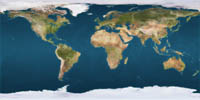
This map is a synthesis between my original earth map, gradient mapping of the USGS DEM information, hand painting, DEM modulation of detail, bathyspheric depth information, and the USGS Ocean clip. Bathyspheric data was used to modulate the color of the water so that deeper areas are a darker blue than shallow areas.
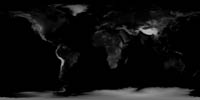
This is pieced together exclusively from the USGS DEM database. It contains landmass elevations only, with the ocean at zero, and the top of Mt. Everest at 255. Use this as a bump map to give the appearance of the Earth's rugged surface features. Some madmen have also used this data in POV Ray as a displacement map on a very finely divided sphere to produce a "true" 3D version of the Earth. The 10K version is VERY large, so make sure you really need that much detail.
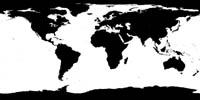
This is derived from USGS DEM data, with the addition of the Arctic ice areas which do not show up on USGS data (since they are not solid land masses.) Use this to control specularity and reflectance of the ocean surface.
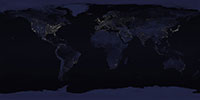
1024 x 512 color image. Very similar to the night lights map as published by NASA on their Blue Marble Page. I took their 30000 x 15000 black and white city lights map, and adapted it with a color table to a colorized version of my earth color map. This comes in 2k, 4k, and 10k versions in color, as opposed to the maximum 2k size of the NASA version of this map (higher resolution versions are available on the paid page only because of their size). Be sure to have a look at the tutorials page for a special rendering tip for using this map.
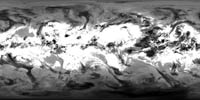
1024 x 512 color image. Based on a mosaic of satellite data, colorized, data errors retouched out, and fixed for seamless wrapping.
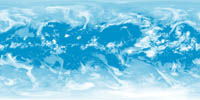
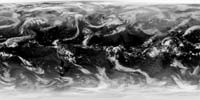
1024 x 512 greyscale image. Based on the same data as the color map, but leveled for the purpose of transparency mapping.

4096 x 2048 greyscale image. Built up out of real satellite imagery based upon a tutorial Dean Scott of Silicon Magic has posted. This is posted in JPEG2000 format. You need a special Photoshop plug-in to make use of jp2 images. I've thoughtfully provided a link:

JPEG 2000 Plugin from Fnord.

Leaked New — Shesayssoooo

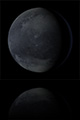
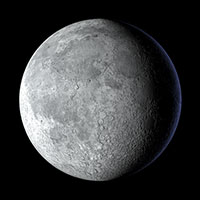
The Moon is a tricky planetoid to render. It has a very distinctive albedo which remains constant across its lit side, regardless of the angle of the surface to the sun. Therefore, standard rendering lighting models do not apply, as they always have a characteristic drop off in intensity as the angle of incidence to the light source increases. In Lightwave, there is an option to use a "non-Lambertian" lighting model on a surface setting. In previous versions of Cinema4D, you had a contrast control in the lighting setup. More recent versions of Cinema4D feature an Oren/Nayar illumination model in the lighting setup which allows you to simulate the lighting properties of "rough" surfaces. This is the method I used on the same pictured here.

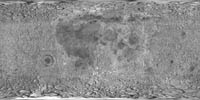
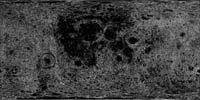
This map is based on a mosaic of satellite data, retouched for visible mosaic seams and for problems with the wrapping seam. Since this image contains highlight and shadow information independent of the location of your light source (inevitable because of how the moon is illuminated by the sun), you'll need to be careful how you light this so you don't break the illusion.

This map is my attempt to derive bump information from the above map. I did a high-pass filter operation to find all the edges of the craters, and then curved the result so that blacks and whites were white, and mid-tones were black. The results came out pretty well, as you can see from the sample image above.


this site works
best on Firefox:


website design © 2006 james hastings-trew